

Get paid ₹100,000 for just liking YouTube videos and sharing links. Limited time offer!
Data Analysis and Decision-Making
Service Overview
Big data processing: AI can quickly analyze massive datasets far beyond human capability.
Predictive analytics: AI can identify trends and forecast outcomes (e.g., in finance, marketing, and healthcare).
Real-time decisions: Used in areas like autonomous vehicles and fraud detection.
Artificial Intelligence (AI) is a rapidly evolving technology that enables machines to simulate human intelligence and perform tasks such as learning, reasoning, problem-solving, and decision-making. It plays a crucial role in modern society by improving efficiency, automating repetitive tasks, and analyzing vast amounts of data far more quickly and accurately than humans can. AI is transforming various industries, including healthcare, where it assists in early disease detection and robotic surgeries; in education, where it personalizes learning experiences; and in transportation, with innovations like self-driving cars. Additionally, AI powers many everyday applications such as voice assistants, recommendation systems, and language translation tools. As AI continues to advance, it has the potential to address global challenges, drive economic growth, and enhance human capabilities—though it also raises important ethical and social considerations that must be managed responsibly..
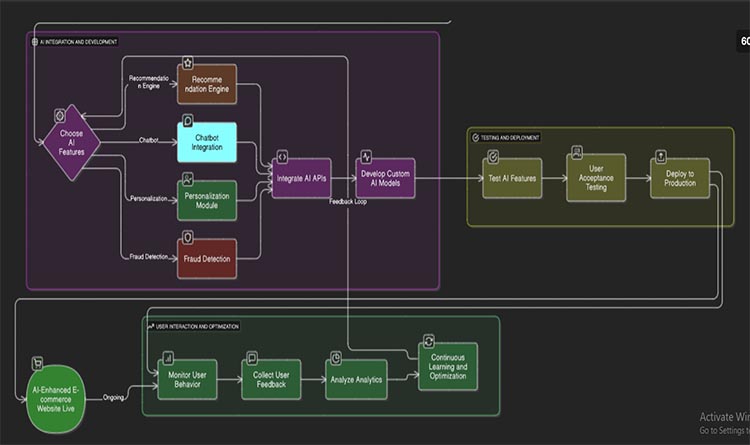
About The flowchart
IIn the context of web design and development for e-commerce, Artificial Intelligence (AI) follows a structured flow that enhances user experience, automates tasks, and boosts business performance. The process begins with **data collection**, where AI gathers customer data from various sources such as browsing history, purchase behavior, and social media interactions. This leads to **user behavior analysis**, where machine learning algorithms identify patterns and preferences. Based on this, **personalized recommendations** are generated—suggesting products tailored to individual users. Simultaneously, AI assists in **automated website design**, using tools like AI-driven layout builders or A/B testing systems to optimize design elements for better engagement. Next, **chatbots and virtual assistants** come into play, providing 24/7 customer support and answering queries in real time. AI also contributes to **inventory and supply chain management** by forecasting demand and automating restocking. Lastly, **performance monitoring** uses AI to track user interaction, site speed, and conversion rates, feeding data back into the system to continuously improve the platform. This AI-driven flow in e-commerce web development ensures a dynamic, responsive, and customer-centric online shopping experience. .
🎯 Chatbots for customer support
🎯Product recommendations on e-commerce websites
🎯Voice assistants (e.g., Siri, Alexa, Google Assistant)
🎯Auto-complete in search bars
🎯Email spam filtering
🎯Face recognition for phone unlocking
🎯Fraud detection in banking
🎯Predictive text while typing
🎯Personalized social media feeds
🎯Language translation in real-time (e.g., Google Translate)
🎯Smart home devices (e.g., thermostats, lights)
🎯Self-checkout systems in stores
🎯Virtual try-on for clothes or glasses
🎯Sentiment analysis of customer reviews
🎯Automatic image tagging (e.g., in Google Photos)